All-Digital Telemetry Receiver
Dual-channel telemetry receiver with pre-detection diversity combining, IRIG-106 LDPC decoding and a 7-inch touchscreen. S-band standard, L- and C-band to 8 GHz on order. Two receivers and a combiner in the enclosure you choose: 3U rackmount, 1U rackmount, or a rugged portable case.
Key specifications
| Demodulation | PCM/FM, SOQPSK-TG, BPSK ARTM CPM (multi-h), PCM/PM, OQPSK/QPSK, STC, analog FM optional |
|---|---|
| Frequency range | S-band 2200–2390 MHz L-, S- and C-band, 1–8 GHz, on order; multi-band units switch bands from the touchscreen |
| Tuning step | 100 kHz |
| Noise figure | 6.5 dB max |
| Data rate | Up to 28 Mbps up to 40 Mbps on request |
| Forward error correction | IRIG-106 LDPC, all six codes: K = 1024 and 4096, rates 1/2, 2/3, 4/5 Viterbi and Reed-Solomon decoding optional |
| Spurious-free dynamic range | > 70 dB |
| IF rejection | > 70 dB |
| IF output | 140 MHz |
| Clock and data outputs | TTL or RS-422 LVDS/ECL, multiple parallel outputs, Ethernet (PCM over UDP, IRIG-106 Chapter 10, TMoIP) optional |
| Reference and inputs | 10 MHz reference in/out, 70/140 MHz IF input, bias-T supply for a mast-head LNA |
| Remote control | Ethernet (TCP, web GUI), RS-232/RS-422, command API SNMP and SCPI on request |
| Signal quality reporting | Eb/N0 (SNR) estimate, signal strength, lock status |
| Channels | 2 receivers + 2-channel pre-detection diversity combiner 1-channel, 4-channel (two combiners) and larger on order |
| Form factor | Choice of 19-inch 3U rackmount, 19-inch 1U rackmount, or rugged portable case rugged case approx. 280 × 200 × 70 mm (11 × 7.9 × 2.8 in), H × W × D |
| User interface | Embedded 7-inch capacitive touchscreen |
Standard configuration shown; optional items are described under Options and customization below. Full specifications, ordering codes and mechanical drawings are in the datasheet.
Two telemetry receivers and a diversity combiner in one enclosure of your choice
The Modulinx All-Digital Telemetry Receiver packs two independent telemetry receivers and a two-channel pre-detection diversity combiner into a single unit, delivered as a 19-inch 3U rackmount, a 19-inch 1U rackmount or a rugged portable case. It demodulates PCM/FM, SOQPSK-TG and BPSK at data rates up to 28 Mbps, 40 Mbps on request, decodes every IRIG-106 LDPC code, and delivers clock and data as TTL or RS-422, with a 140 MHz IF output for recorders and legacy equipment.
The signal path is digital from the IF onward. Receiver behavior is therefore repeatable from unit to unit and from mission to mission, and capabilities are added as software or as ordered options rather than as replacement hardware: additional bands anywhere from 1 to 8 GHz, more channels, Ethernet outputs, antenna tracking signals, PCM processing, recording, video.
It is built for flight-test ranges, missile and munitions test, UAV programs and transportable ground stations that need a link that holds through antenna nulls, multipath and vehicle maneuvers, and it is configured to the range rather than the other way round, down to the enclosure: the same receiver ships as a 3U rackmount for the equipment room, a 1U rackmount for dense racks, or a rugged case of approx. 280 × 200 × 70 mm (11 × 7.9 × 2.8 in) for the field.
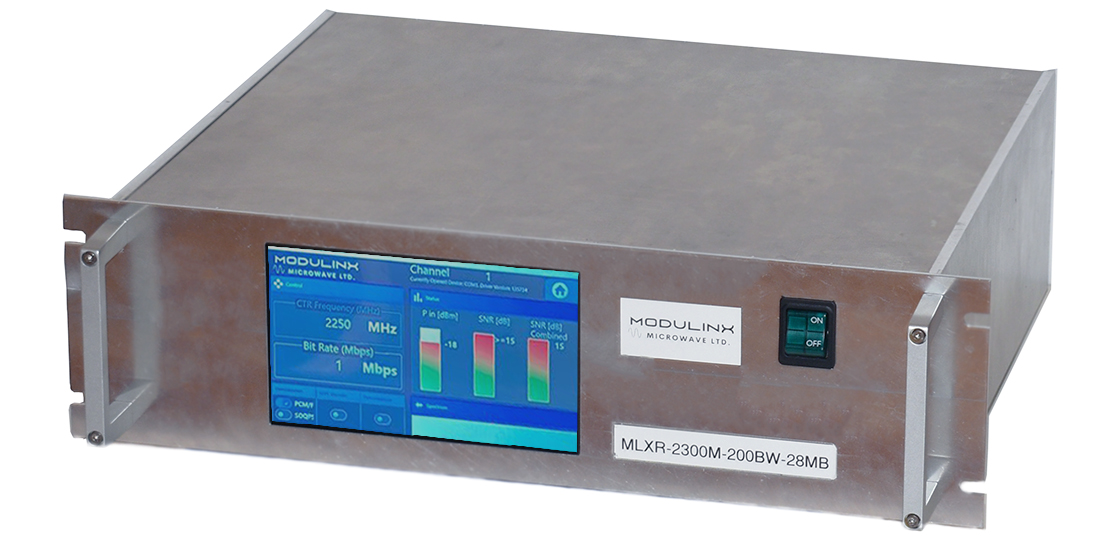
One receiver, three enclosures: 3U, 1U or rugged case
The same all-digital receiver, combiner and firmware ship in the enclosure that fits the station. Choose at order; the configuration, interfaces and options stay the same.
19-inch 3U rackmount
The standard enclosure, 3 rack units (133 mm / 5.25 in) high, with the embedded 7-inch capacitive touchscreen on the front panel, for fixed ground stations and shelters where the operator works at the rack.
19-inch 1U rackmount
The low-profile version, 1 rack unit (44 mm / 1.75 in) high, for dense racks and multi-receiver stations, operated over the Ethernet or RS-232/RS-422 remote interface from range control software.
Rugged portable case
A robust portable enclosure of approximately 280 mm × 200 mm × 70 mm (11 in × 7.9 in × 2.8 in), height by width by depth, for vehicles, ships, field teams and quick-reaction deployments where there is no rack at all.
Pre-detection diversity combining for a link that survives maneuvers
Telemetry links fail at the worst moments: when the vehicle rolls and its antenna pattern nulls toward the ground station, when multipath off the ground or sea cancels the direct path, or when polarization rotates during a maneuver. Diversity reception feeds the receiver from two antennas, or from the two polarizations of one antenna (typically LHCP and RHCP), and merges them into one signal.
The All-Digital Telemetry Receiver combines its two channels before detection, weighting each by its signal-to-noise ratio. Pre-detection combining outperforms simply selecting the stronger channel or combining after demodulation, because the two signals add coherently while their noise does not. The combined output is better than either input whenever both carry signal: up to 3 dB when the channels are equal, and far fewer dropouts when they are not.
Both receivers and the combiner share one chassis, one touchscreen and one configuration, so a dual-channel diversity station fits in one enclosure, 3U or 1U in the rack or the rugged case in the field, instead of three separate boxes. The combined output and both individual channels can be delivered simultaneously, so a recorder can capture all three.
Every IRIG-106 waveform and every IRIG-106 LDPC code
The standard receiver demodulates the waveforms flight-test programs actually fly. PCM/FM is the IRIG-106 Tier 0 waveform and the long-standing workhorse of aeronautical telemetry, and the receiver applies multi-symbol trellis detection to it for extra sensitivity. SOQPSK-TG, the Tier I waveform, fits the same data rate into roughly two-thirds of the bandwidth PCM/FM needs. BPSK is included for programs that use it.
For programs with other waveforms, ARTM CPM (multi-h CPM, the Tier II waveform for the most crowded spectrum), PCM/PM, OQPSK and QPSK, space-time coding (STC) for two-antenna vehicles, and analog FM for video links are available as ordered options.
All six IRIG-106 low-density parity-check (LDPC) codes are decoded: information block sizes of 1024 and 4096 bits at code rates 1/2, 2/3 and 4/5. That lets the ground station follow whatever the airborne transmitter was configured for, from the highest-margin rate-1/2 code to the most spectrally efficient rate-4/5 code. The coding gain of LDPC translates directly into link margin, which a program spends as it chooses: longer range, a smaller ground antenna, a lower-power transmitter, or a link that stays up through deeper fades. Viterbi and Reed-Solomon decoding are available for legacy links that still use them.
Pair it with the Modulinx All-Digital S-Band Telemetry Transmitter, which encodes the same LDPC codes and generates the same waveforms, for an end-to-end IRIG-106 link from one supplier.
L-, S- and C-band, from 1 to 8 GHz
Standard coverage is S-band, 2200–2390 MHz, tuned in 100 kHz steps. Coverage anywhere from 1 to 8 GHz can be ordered: the L-band (1435–1535 MHz) and upper L-band (1750–1850 MHz) allocations, S-band, and the C-band ranges at 4400–4940 MHz and 5091–5150 MHz that more and more programs are moving to. A unit ordered with more than one band switches between them from the touchscreen, without hardware changes or a separate down-converter.
A maximum noise figure of 6.5 dB keeps sensitivity high without an external preamplifier in many installations, and greater than 70 dB of spurious-free dynamic range and IF rejection keep a weak signal recoverable next to strong ones on a busy range. Where a mast-head LNA is used, the receiver can power it through the coax via a bias-T.
A 10 MHz reference input and output lock the receiver to the station's frequency standard, or let it serve as the reference for other equipment. Besides the RF inputs, a 70 or 140 MHz IF input accepts the output of an existing down-converter or a wideband recorder on playback, and the 140 MHz IF output feeds recorders, spectrum monitors and legacy demodulators unchanged.
Outputs and remote control that drop into an existing ground station
Clock and data leave the receiver as TTL or RS-422, straight into decommutators, bit-error-rate test sets and recorders. LVDS and ECL outputs, several parallel clock-and-data outputs feeding different consumers, and an Ethernet output carrying the PCM stream over UDP or as IRIG-106 Chapter 10 packets (telemetry over IP, TMoIP) are available for stations that route data over the network rather than over coax.
Operators configure frequency, band, modulation, data rate, FEC and combiner mode on the embedded 7-inch capacitive touchscreen, without a laptop and without reaching around the back of the rack. For range control software, the same settings are available remotely over Ethernet (TCP, with a web GUI) and over RS-232/RS-422, through a documented command set; SNMP and SCPI can be added on request.
Signal quality is reported, not guessed: the receiver estimates Eb/N0, reports signal strength per channel and combiner, and flags lock status, all readable over the remote interface, so a range controller can watch link margin in real time and know when a fade is coming rather than after the data is gone.
Options and customization
The all-digital platform is configured per program. Everything below is orderable; tell us what the range needs and it becomes part of the quotation.
Channels and form factors
- Single-channel receiver for a single-antenna station
- Four-channel receiver with two pre-detection combiners, and larger channel counts per chassis
- Enclosure of your choice: 19-inch 3U rackmount, 19-inch 1U rackmount, or rugged portable case
- Rugged case approx. 280 mm × 200 mm × 70 mm (11 in × 7.9 in × 2.8 in), height × width × depth, for portable, vehicle and field stations
Antenna tracking
- AGC and AM tracking outputs for an antenna control unit (ACU)
- Conical-scan (conscan) and monopulse tracking support
- Specified per program, matched to the antenna system on the range
PCM processing and built-in test
- Bit synchronizer with IRIG derandomizer
- Frame synchronizer
- Data polarity and inversion control; NRZ / Bi-phase code conversion
- Viterbi and Reed-Solomon decoding for legacy links
- Built-in bit-error-rate tester and PN pattern generator
- Loopback test modulator for station self-test without a vehicle
Recording, time and video
- Built-in IF or PCM recording
- IRIG-B time input for time-stamping
- H.264 / H.265 compressed-video link: the video stream is delivered from the receiver over UART or as RS-422 clock and data
Power, cooling and environment
- AC 100–240 V or 28 VDC input
- Extended operating temperature range
- MIL-STD-810 qualification for shelters, vehicles and shipboard installations
- Conduction-cooled version
Display, availability and security
- Spectrum, constellation and eye-diagram display on the touchscreen
- Redundant configurations with automatic failover
- AES-256 encrypted links end-to-end with the Modulinx transmitter
Where the All-Digital Telemetry Receiver is used
Fixed and transportable telemetry stations that cannot afford a dropped link.
Flight-test ranges and ground stations
Fixed-wing, rotary-wing and engine test programs tracking a single vehicle through the full flight envelope.
Missile and munitions test
Short, high-dynamics flights where every second of data counts and there is no second attempt.
UAV and target programs
Long endurance, low-elevation links where multipath and antenna nulls are routine rather than exceptional.
Transportable and mobile telemetry
A complete dual-channel diversity station in whichever enclosure the platform allows: 3U or 1U in a rack, or the rugged 280 × 200 × 70 mm (11 × 7.9 × 2.8 in) case for vans, shelters, ships and field teams.
Lab validation and pre-flight checks
Verify the airborne transmitter, modulation and LDPC settings on the bench with the same receiver used on the range.
Range modernization
Replace analog receiver and combiner racks with one software-configurable unit, keeping the 140 MHz IF for existing recorders and adding Ethernet for the new ones.
Delivery, warranty and field support
Every receiver is built to the ordered configuration. Typical lead time is about six months; the exact figure is stated in the quotation together with the configuration. The receiver needs no periodic calibration, and the warranty runs two to three years depending on the contract.
Modulinx engineers come to the range. Acceptance testing, integration into the ground station and participation in field trials are available as paid services, in Israel and abroad, and we take part in any field test that involves our equipment.
Modulinx products are designed and manufactured in Israel and exported under Israeli MoD export licensing.
Telemetry receiver FAQ
What does "all-digital" mean in a telemetry receiver?
The signal is digitized at the intermediate frequency, and demodulation, bit synchronization, diversity combining and LDPC decoding are performed in digital logic rather than in analog circuits. Performance is repeatable across units, there is no analog drift to re-tune, and new modes are added by software.
Which bands does it cover?
S-band, 2200–2390 MHz, as standard. Coverage anywhere from 1 to 8 GHz can be ordered, including L-band, upper L-band and both C-band telemetry allocations, and a multi-band unit switches between its bands from the touchscreen.
Which modulations and data rates are supported?
PCM/FM (with multi-symbol trellis detection), SOQPSK-TG and BPSK as standard, at data rates up to 28 Mbps, and up to 40 Mbps on request. ARTM CPM (multi-h), PCM/PM, OQPSK/QPSK, STC and analog FM are available as options.
Which LDPC codes does it decode?
All six IRIG-106 LDPC codes: information block sizes of 1024 and 4096 bits at code rates 1/2, 2/3 and 4/5. Viterbi and Reed-Solomon decoding can be added for legacy links.
What is pre-detection diversity combining, and do I need it?
It merges two receiver channels, from two antennas or two polarizations, into one signal before demodulation, weighting each channel by its signal quality. If your vehicle maneuvers, flies low over terrain or water, or uses a single antenna with deep pattern nulls, diversity combining is the difference between a few dropouts per flight and none.
How many channels can I order?
The standard unit holds two receivers and a two-channel combiner. Single-channel units, four-channel units with two combiners and larger channel counts are available, in any of the three enclosures.
Which enclosures are available?
Three, and you choose: a 19-inch 3U rackmount with the 7-inch touchscreen, a 19-inch 1U rackmount for dense racks, and a rugged portable case of approximately 280 mm × 200 mm × 70 mm (11 in × 7.9 in × 2.8 in), height × width × depth, for vehicle and field use. The receiver, combiner, interfaces and options are the same in all three; you choose the enclosure at order.
What outputs and interfaces does it provide?
Clock and data as TTL or RS-422, a 140 MHz IF output, 10 MHz reference in/out and a 70/140 MHz IF input as standard. LVDS/ECL and multiple parallel outputs, Ethernet output (PCM over UDP, IRIG-106 Chapter 10, TMoIP), AGC/AM outputs for antenna tracking and IRIG-B time input are options. Remote control runs over Ethernet and RS-232/RS-422 with a documented command set.
Can it carry video?
Yes. An H.264 / H.265 compressed-video option delivers the video stream from the receiver over UART or as RS-422 clock and data, and analog FM demodulation is available for legacy video links.
What are the lead time and warranty?
Typical lead time is about six months, stated precisely in the quotation. Warranty is two to three years depending on the contract, and the receiver needs no periodic calibration. Field support by Modulinx engineers, in Israel or abroad, is available as a paid service.
Can you export to my country?
Modulinx exports under Israeli Ministry of Defense export licensing and supplies customers in Israel, the United States and every other country approved by the Israeli authorities. Tell us where the equipment will be used and we will confirm before quoting.
How do I get the datasheet or a quotation?
Use the Download datasheet button on this page for the full specification, or send us your bands, channel count, data rates and the options you need through the contact page and we will return a configuration and a quotation with lead time.
Complete the link
All-Digital S-Band Telemetry Transmitter
MLXT-2250 series: up to 10 W GaN output, SOQPSK-TG and PCM/FM, the same IRIG-106 LDPC codes, RS-422 and USB control, AES-256 option. Flight-qualified for airborne, missile and UAV test.
See the transmitterCable assemblies and wire harnesses
Build-to-print RF, power and data cable assemblies for the receiver, the transmitter and everything between them, made under an AS9100-aligned workflow.
See cable assembliesSpecifying a receiver for your range?
Send us the bands, channel count, data rates and options. We will come back with a configuration and a quotation.